China Best Large Outdoor Ceramic Flower Pots Supplier
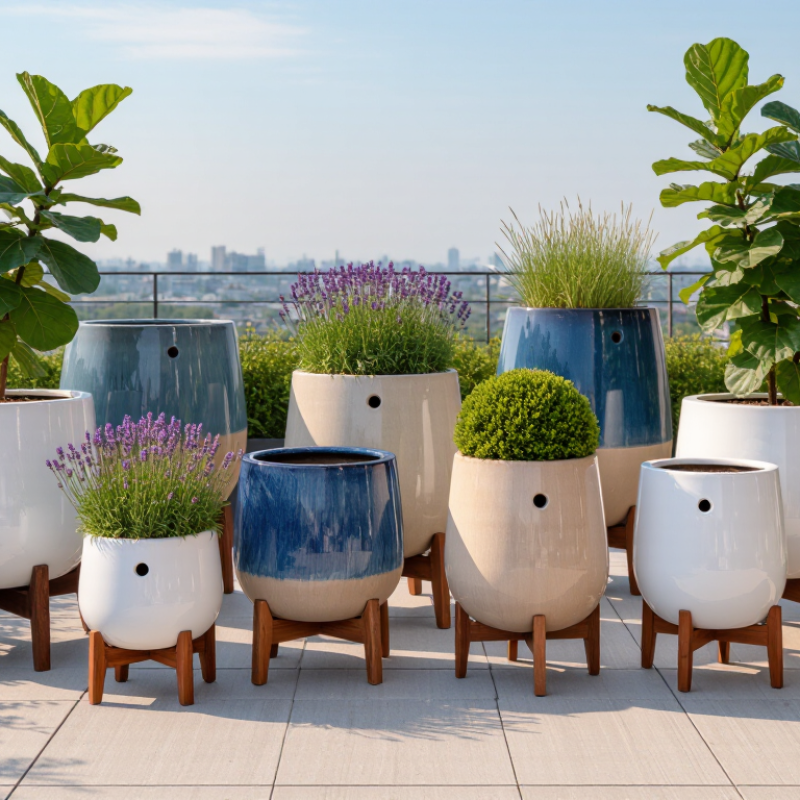
Choosing ceramic flower pots large outdoor spaces requires more than selecting an impressive shape. A planter must suit the plant, the site, and the weather it will face. A wide pot can anchor an entrance, while a deep container gives roots more room. But weight matters. A large ceramic planter filled with damp soil can be difficult to move.
Design offers a useful starting point. The influential designer William Morris wrote, “Have nothing in your houses that you do not know to be useful, or believe to be beautiful.” His principle is not specific to outdoor planters, but it fits the choice well: appearance and function should meet. Look closely at glaze consistency, drainage openings, wall thickness, and the base. Ask suppliers how they inspect pieces and protect them for shipping. Details show.
A reliable supplier should explain dimensions and care clearly, not rely on attractive photographs alone. Ask whether each pot is suitable for exposed patios, windy balconies, or covered entrances. These conditions are not interchangeable. A glossy finish may look striking, yet surface variation can be part of handmade production. That deserves honest disclosure, not a surprise on delivery.
This guide explores how to assess a China-based supplier, compare large outdoor ceramic pots, and check practical details before ordering. One caution remains: even a well-made pot can crack if moved carelessly or exposed to unsuitable conditions. Choosing well helps, but it does not remove every risk.
Defining Large Outdoor Ceramic Flower Pots and China Supplier Capabilities
China Best Large Outdoor Ceramic Flower Pots Supplier
Large outdoor ceramic flower pots have no universal size cutoff. Buyers commonly define “large” by rim diameter, height, volume, and loaded weight. A pot measuring 45 centimetres across can hold a small tree, but wet soil makes handling harder. Drainage holes, wall thickness, and a stable base matter. Details matter. A glazed sample alone cannot prove outdoor durability.
China’s ceramic supply base can support mold development, glaze trials, kiln production, and export packing. Grand View Research estimated the global ceramic tiles market at US$227.1 billion in 2023; this is broader sector context, not a flower-pot market figure. For buyers, factory capability is best checked through measurable tests: compare dimensions across samples, inspect drainage, and request water-absorption and freeze–thaw results for the intended climate. The ASTM C373 test method measures water absorption in ceramic products, though a test result should be interpreted for the specific pot body and use conditions. Ask suppliers how they control firing variation and protect rims during pallet shipment. A beautiful sample can still mislead. Batch records and pre-shipment inspection help, but they do not replace checking a delivered production lot.
Ceramic Body Benchmark: ISO 13006 Class BIa Sets Water Absorption at ≤0.5%
Large outdoor ceramic pots face more than visual wear. Rain can sit around the base, while damp soil keeps the inner wall wet for hours. For this reason, a ceramic body’s water absorption deserves close attention. ISO 13006 Class BIa uses a threshold of no more than 0.5%. That figure is a useful benchmark for dense ceramic material.
There is an important detail. ISO 13006 classifies ceramic tiles, so a flower pot should not automatically be described as certified BIa. Ask the supplier what product and test method the reported result covers. Request test documentation for the ceramic body, not just the glaze. A glossy surface may look sealed while the underlying clay remains more absorbent. Details matter.
Lower absorption can reduce water uptake, but it does not guarantee that a pot will withstand every winter. Check whether the supplier also evaluates freeze-thaw performance, wall thickness, firing consistency, and drainage design. A broad, open drainage hole helps prevent water from collecting at the bottom. I would also inspect sample pots for hairline cracks near the rim and base. The absorption figure is valuable, but it cannot tell the whole story.
Freeze–Thaw Testing: ISO 10545-12 Evaluates Ceramic Tile Frost Resistance Over 100 Cycles
Large outdoor ceramic flower pots face repeated wetting, freezing, and thawing. Water can enter tiny pores in the fired body. When it freezes, expansion may contribute to cracking, surface flaking, or glaze damage. The effects are not always visible after one cold night.
ISO 10545-12 assesses the frost resistance of ceramic tiles through repeated freeze–thaw cycles. In the test, water-saturated specimens undergo controlled freezing and thawing, then are checked for visible damage. The 100-cycle sequence provides a useful comparison under a defined laboratory method. Small details matter: specimen preparation, water saturation, and temperature control can affect results. It is a demanding test.
A pot is not a tile. Passing this test on tile samples does not automatically prove that a finished flower pot will perform identically. Shape, wall thickness, drainage holes, glaze, and manufacturing variation all influence how moisture behaves. For buyers comparing outdoor planters, ask whether test pieces came from the same clay body and firing process as the pots. Also check for inspection records and clear descriptions of any visible changes after cycling. One honest limitation: laboratory cycles cannot reproduce every garden, where standing water and uneven frost exposure may create harsher conditions.
Supplier Evaluation: Check Quality Control, Samples, Packaging, and Export Experience
When comparing suppliers of large outdoor ceramic flower pots, ask how quality is checked at each production stage. Request details on clay preparation, firing temperature records, glaze inspection, and final measurements. Check the pot’s rim, drainage hole, and base for chips, uneven glaze, or wobble. Small flaws matter. A heavy pot can look sound but still crack during handling or temperature changes.
Request samples from a regular production run, not only a specially prepared display piece. Inspect the finish in daylight and measure the wall thickness and opening. If possible, fill the pot with water and check for seepage around the base. One sample is not proof. Ask how the supplier handles defects and whether approved sample specifications are recorded for repeat orders. Photos help, but they cannot reveal every flaw.
Packaging deserves a practical review. Ask for photos of the actual packing method, including rim protection, dividers, and pallet securing. Confirm whether the packing suits the pot’s size and your shipping route; a box that works for one size may fail for another. Suppliers with export experience should explain typical lead times, packing lists, and how they coordinate shipment documents. Do not rely on a polished catalog alone. Clear answers are useful, though delays and breakage can still happen.